

How Google Ads Work in 2026
Google Ads has come a long way since it launched as Google AdWords back in October 2000. Back then, the pitch was simple: pay to show up when someone searches for what you sell. That core idea hasn’t changed — but nearly everything else has.
Expanded text ads are gone. Targeting options come in various forms. There are entire campaign types that didn’t exist in 2020. Last but not least, AI continues to grow and become more prevalent.
This Odd Dog guide covers how Google Ads works today — the campaign types, how to set up Google Ads, the AI-powered tools that are increasingly doing the heavy lifting, and what you need to know heading into 2026. Whether you’re a small business owner who doesn’t know what Google Ads are, or a marketing manager overseeing a paid search program, this guide is for you.
Jump to a Section:
- Google Ads in 2026
- Campaign Types
- What’s New: AI in Google Ads
- Setting Yourself Up for Success
- Campaign Setup Overview
- What to Expect in 2026
- FAQs
Google Ads in 2026
The Basics Haven’t Changed — But the Scale Has
What are Google Ads? It is still a pay-per-click (PPC) advertising platform at its core. You bid to show ads to people based on what they’re searching for, who they are, or what content they’re consuming. You only pay when someone clicks.
What has changed is the sheer scale and sophistication of the system. Google now processes over 16.4 billion searches per day. Its ad platform spans Search, YouTube, Gmail, Google Maps, Google Display Network, Google Discover, and now AI-generated search experiences. When you run Google Ads, you’re not just buying keywords; you’re buying access to the most widely used information infrastructure on the planet.
Where Your Ads Can Appear in 2026
In 2020, the conversation was mostly Search vs. Display. Today, Google Ads reaches users across a much wider surface area:
- Google Search
- Google Display Network (GDN)
- YouTube
- Gmail
- Google Discover
- Google Maps
- Google Shopping
- AI Overviews
- AI Mode
The Big Shift: From Manual Control to AI-Driven Automation
The most significant change in Google Ads over the past few years isn’t any single feature; it’s the underlying philosophy. Google has steadily moved from a system in which advertisers manually controlled nearly everything (keywords and ad copy) to one in which AI makes many of those decisions automatically.
This is a real adjustment for experienced advertisers. The instinct is to want maximum control. But the data increasingly shows that AI-assisted campaigns, when given good inputs, outperform heavily manual campaigns. The key phrase there is when given good inputs. The AI is only as smart as the data you feed it: your conversion signals, audience lists, creative assets, and budget.
We’ll come back to this throughout the guide. The short version: embrace automation, but don’t abdicate responsibility for strategy.
New Ad Types Worth Knowing
Performance Max is Google’s AI-driven campaign type that runs across all of the channels above simultaneously, Search, Display, YouTube, Gmail, Discover, Maps, and Shopping, in a single campaign. Instead of managing individual placements and bids, you give Google a budget, a goal, and a set of creative assets, and its AI figures out where and how to show your ads.
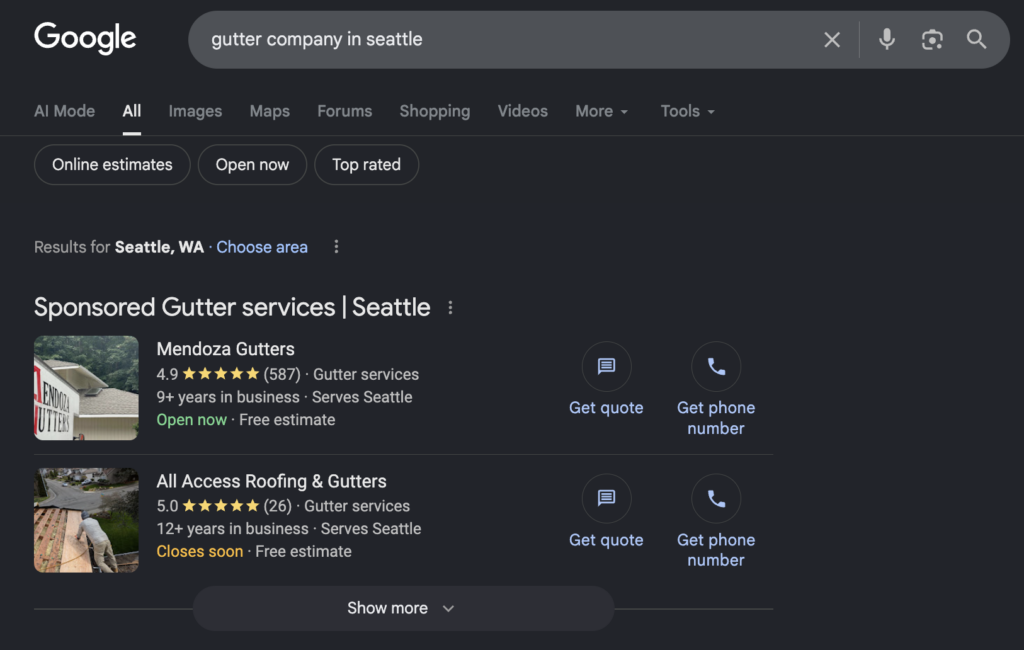
Local Services Ads (LSAs) have been around since 2019, but haven’t gained as much attention until recently. They are a separate Google product specifically for local service businesses; home services, legal, healthcare, and more. Unlike standard Google Ads, LSAs charge per lead rather than per click, and appear at the very top of search results above regular ads. For qualifying businesses, they’re often the highest-ROI starting point in Google’s ecosystem.
Campaign Types — A 2026 Overview
Here’s a current breakdown of the campaign types, their best use cases, and other notable information.
Search Campaigns
Google Search Ads are the original Google Ads format. They are text ads triggered by keyword searches that appear at the top and bottom of Google’s search results page.
Best for: High-intent, bottom-of-funnel users actively seeking what you offer. This includes generating leads through a form or phone call.
What’s new: New in 2025 and arguably the most important development for Search advertisers is AI Max for Search. AI Max isn’t a new campaign type — it’s a suite of AI-powered features you can layer onto existing Search campaigns. Think of it as Search campaigns with the intelligence turned up significantly. Key AI Max features include Search Term Matching, URL Expansion, and more.
When to use it: Almost always. Search campaigns should be the foundation of most Google Ads accounts. If someone is searching for exactly what you do, you want to be there.
Display Campaigns
Display Ads are visual ads that are shown across Google’s network of up to 35 million websites, apps, and Google-owned properties.
Best for: Brand awareness, retargeting past website visitors, and reaching users earlier in the buying journey.
What’s new: Google has added AI-powered creative tools to Display — you can now animate static images, adjust aspect ratios, and generate new creatives from existing brand assets. Display inventory now also includes placements on X (formerly Twitter) via the Google Display Network.
When to use it: Retargeting campaigns for almost any business. Awareness campaigns for businesses with longer sales cycles or higher-consideration purchases.
Video (YouTube) Campaigns
Video ads are served before, during, or after YouTube videos, as well as in YouTube search results, and across the Google Video Partners network.
Best for: Brand awareness, product demonstrations, telling a story that requires more than a headline and description.
When to use it: When you have video creative and ad spend budget to invest in upper-funnel awareness. It is also effective for retargeting.
Performance Max (PMax)
Performance Max is a single campaign type that runs across all of Google’s channels simultaneously, using Google’s AI to allocate budget where it predicts the best conversions.
Best for: Advertisers who want full-funnel coverage and are willing to trust Google’s AI to find converting users across channels. If your goal is to drive in-store traffic, PMax’s full-channel coverage is a valuable asset.
What you control:
- Your budget and bidding goal
- Asset groups
- Audience signals
- Brand exclusions
What you don’t directly control: Which channels get ad spend, which ad formats run, and individual placement choices.
When to use it: When you have solid conversion tracking set up and enough conversion volume for the AI to learn. It can be a black box, and it requires ongoing asset testing as well as audience signal refinement. Don’t set it and forget it.
Demand Gen Campaigns
Formerly known as Discovery campaigns, Demand Gen was rebuilt in 2023–2024 to focus on capturing demand in visual, content-native environments: YouTube (including Shorts), Gmail, and Google Discover.
Best for: Mid-funnel awareness and consideration, targeting users who aren’t actively searching, but they’re open to discovery.
When to use it: As part of a full-funnel strategy alongside Search and Performance Max. Good for brands with strong visual creative.
Shopping Campaigns
Shopping ads list products directly in Google Search results with an image, title, price, and store name. This is essential for e-commerce businesses.
Best for: Online retailers with a product feed. Shopping ads tend to have high purchase intent since users can see the product and price before clicking.
When to use it: You are an e-commerce business.
App Campaigns
These are designed specifically to drive mobile app installs or in-app actions. Google’s AI automatically creates and optimizes ads across Search, Display, YouTube, and Google Play.
Best for: Mobile app developers and businesses with an app they want to grow.
Local Services Ads (LSAs)
LSAs appear above standard Google Ads at the very top of search results when someone searches for a local service. They show your business name, rating, and number of reviews.
What makes LSAs different from regular Google Ads:
- Pay per lead, not per click. You’re charged when a potential customer calls, messages, or books through your ad — not just when they click. This makes the ROI math much more straightforward.
- Google Verified. To run LSAs, your business goes through a background check and license verification process. This process is intended to provide a credibility signal to consumers making high-stakes purchasing decisions.
- No keywords to manage. Google matches your ads to relevant local searches automatically based on your business category, services, and location. Setup is significantly simpler than traditional Search campaigns.
- LSAs live on a different platform. Although LSAs are a form of Google Ad, you cannot find LSAs within the Google Ads interface. It lives in its own separate platform.
Who qualifies: LSAs are available for a specific list of business categories, including home services, legal services, financial planning, and more. Google continues to expand the list of eligible categories. Check their website to see if your industry is eligible.
How the LSA auction works: Unlike Google Ads, which relies heavily on bid amounts and Quality Score, LSA rankings are primarily determined by your proximity to the searcher, your review score and volume, your responsiveness to leads, and how well your business category and services match the search. Budget still plays a role; if you’ve hit your weekly budget cap, your ads won’t show, but it’s less of a pure bidding war.
Best for: Any local service business in an eligible category. Home services such as plumbers, HVAC, electricians, roofers, cleaners, and landscapers see strong performance from LSAs. If you’re not running them already and you qualify, this is often the highest-priority recommendation we make.Running LSAs alongside Google Ads Search campaigns: These two ad types complement each other well. LSAs capture leads at the very top of the page with a trust-heavy format. Search campaigns give you more control over targeting, messaging, and landing page experience. Running both maximizes your presence on the search results page and covers different searcher intents and behaviors.
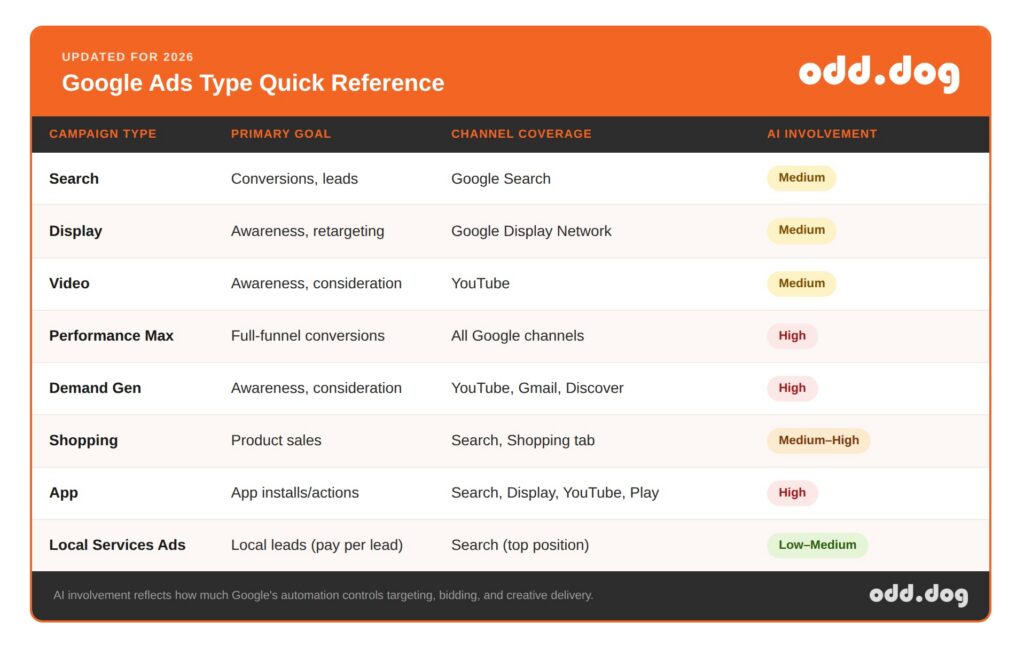
Campaign Type Quick Reference
Not sure which campaign types make sense for your business?
Every account is different. A 30-minute conversation with Odd Dog might give you a clear picture of where your ad spend should go and what campaign structure will work best for your goals.
What’s New: AI in Google Ads
The biggest story in Google Ads since 2020 is AI, and it’s not optional anymore. Here’s a plain-English overview of the most important AI-driven developments.
Performance Max
Performance Max (PMax) is Google’s AI-driven campaign type. You set a budget and goal, provide creative assets and audience signals, and Google’s AI handles the rest.
It works well when you have solid conversion tracking in place and enough monthly conversions (30–50+) for the AI to learn from. Without that data foundation, it tends to cast too wide a net. Recent updates have added campaign-level negative keywords and better search term reporting, which addressed two of the biggest complaints advertisers had about transparency and control.
PMax isn’t a replacement for Search campaigns — it’s a complement.
Other AI Features Worth Knowing
AI Max for Search is a suite of features you can layer onto existing Search campaigns to expand reach with keywordless targeting, dynamic ad copy, and smarter URL routing. Think of it as Search campaigns with more AI involvement. It’s worth testing once your account has enough conversion data to support it.
Ads in AI Overviews — Google now shows ads inside the AI-generated summaries that appear at the top of many search results. You can’t bid specifically for this placement, but well-structured campaigns with high Quality Scores and relevant landing pages are more likely to qualify.
Asset Studio lets you generate ad images and short videos using Google’s AI directly inside the platform — useful if you don’t have a dedicated creative team.
Setting Yourself Up for Success
Before you start considering the different Google Ads platforms, there’s strategic groundwork worth doing. The businesses that get the most out of Google Ads aren’t necessarily the ones with the biggest budgets — they’re the ones who started with clarity on these four things.
Know Your Goal
This sounds obvious, but it’s the most commonly skipped step. Google Ads can do a lot of things — drive phone calls, generate form submissions, increase online sales, build brand awareness, and bring people through the door. But a campaign trying to do all of those at once tends to do none of them well.
Before you build anything, answer this: What does a successful outcome actually look like for your business? Is it a new customer calling to book a job? A purchase completed on your website? A form submitted by a qualified lead? The clearer you are here, the easier everything else becomes — which campaign type to use, how to measure performance, and what a realistic budget looks like. Make sure you have proper tracking setup as well.
Know Your Numbers
Google Ads works best when you know what a customer is worth to your business. If you have no idea what you can afford to pay for a lead or a new customer, it’s very difficult to set a sensible budget or evaluate whether your campaigns are actually working.
A few numbers worth having before you start:
- Average customer value — what does a typical new customer spend with you, either in a single transaction or over time?
- Close rate — of the leads you receive, how many turn into paying customers?
- Acceptable cost per lead — given the above, what’s the maximum you’d be willing to pay for a qualified inquiry?
You don’t need precise figures — reasonable estimates will do. But having a rough target will help you work towards a suitable ad budget.
Know Your Audience
Who are you trying to reach? The more specifically you can describe your ideal customer — their location, their situation, what they’re searching for, what problem they’re trying to solve — the better you can target your campaigns and write ads that resonate.
For local service businesses, this is often straightforward: homeowners within a 20-mile radius searching for a specific service. For businesses with broader audiences, it takes more thought. Either way, having a clear picture of your target customer before you start will shape your keyword choices, ad copy, landing page, and bidding strategy.
Make Sure Your Website Is Ready
Clicks that don’t convert are just money spent. Before investing in Google Ads, take an honest look at your website, specifically the pages you plan to send traffic to.
Ask yourself: if someone clicked your ad and landed on this page, would they immediately understand what you do, why you’re the right choice, and how to contact you or take the next step? If the answer is anything other than a clear yes, the landing page is worth fixing before the campaign goes live. A well-optimized landing page can make the difference between a campaign that breaks even and one that generates a strong return.
Not sure if Google Ads are a good fit?
Campaign Setup Overview
Once you’ve done the strategic groundwork, the actual campaign build comes down to three core decisions: what type of campaign to run, how to structure it, and how to target the right audience.
Choose Your Campaign Type
Your campaign type should match your goal. For most businesses starting out, Search is the right foundation — it captures people who are already looking for what you offer.
Build a Clean Structure
How you organize your account affects both performance and ease of management over time. The two levels to think about are campaigns and ad groups.
Campaigns are where you set your budget, bidding strategy, and top-level targeting. If you have services or products that need their own budgets, they each need their own campaign. Keep things separate enough that you can see clearly what’s working.
Ad groups live inside campaigns and organize ads around a specific theme or service. A roofing company, for example, might have separate ad groups for roof repair, roof replacement, and gutter installation — each with its own keywords and ads. Keeping ad groups focused makes your ads more relevant and your Quality Score stronger.
Set Your Targeting
Targeting determines who sees your ads and when. Each ad type has different targeting options so it will depend on which you choose. For Search, it will revolve around target keywords. For Performance Max, you choose Audience Signals.
What to Expect in 2026
Google Ads in 2026 and beyond will continue the trends that defined 2025 — more AI, less manual control, and new surfaces where ads appear. Here’s what to watch:
AI Mode expansion: Google’s conversational search mode is in US testing as of early 2026 and will almost certainly expand. Advertisers who have well-structured accounts and high-quality assets will be best positioned for this inventory.
Keywordless targeting growth: AI Max for Search and Performance Max are both pushing toward a future where keywords are one input among many, rather than the central organizing principle. This doesn’t mean keywords are going away, but their role is evolving.
Creative quality maturity: With Asset Studio and AI-generated creatives becoming standard, the bar for what “good creative” looks like is rising. Anyone can generate a passable image ad. The differentiator will be creative that’s genuinely on-brand and speaks directly to your audience.
Privacy-driven measurement: As regulatory pressure around data privacy continues in the EU and increasingly in the US, advertisers who have invested in first-party data strategies, Enhanced Conversions, and offline conversion imports will have a meaningful advantage over those relying on third-party signals.
Marketing diversification: More people are adopting AI platforms and treating them as a search engine. Google still maintains a large market share of search, but AI usage will surely grow, and there are already talks of AI platforms having their own search ads. Don’t put all of your eggs in the Google Ads basket; be prepared to adapt and diversify your marketing portfolio.
Our take: The fundamentals of Google Ads, strong intent alignment, quality landing pages, clear conversion tracking, and patient optimization, are the same as they’ve always been. The tools change. The strategy principles don’t.
Want Odd Dog to manage your Google Ads?
We manage Google Ads for businesses across the Pacific Northwest and beyond with local representatives in Seattle, Portland and Salt Lake City. If you’d rather spend your time running your business than managing ad campaigns, we’d love to talk.
Google Ads FAQs
How much does Google Ads cost?
There’s no minimum spend requirement — you can technically start with a few dollars a day. In practice, we recommend a minimum monthly budget of $1,000–$1,500 for Search campaigns to generate enough data to optimize meaningfully. Competitive markets (legal, home services, healthcare) often require significantly more. Your cost per click depends on your industry, keywords, quality score, and competition.
What is Performance Max?
Performance Max is Google’s AI-driven campaign type that runs across all of Google’s channels (Search, Display, YouTube, Gmail, Discover, Maps, and Shopping) in a single campaign. You provide a budget, creative assets, and audience signals; Google’s AI allocates spend toward wherever it predicts the best conversions.
What is AI Max for Search?
AI Max is a suite of AI-powered features that can be applied to existing Search campaigns. It expands Search campaigns with keywordless targeting, dynamic ad copy, and smarter URL routing — giving Search campaigns some of the AI-driven capabilities previously only available in Performance Max.
How long does it take to see results from Google Ads?
You’ll typically see traffic within days of launch. Meaningful conversion data usually takes 4–8 weeks to accumulate. AI-driven campaigns (especially Performance Max) have a learning period of 6–8 weeks before they reach peak performance. Budget for at least 3 months before drawing firm conclusions about a campaign’s viability.
Should I use Google Ads or Meta Ads?
They serve different purposes. Google Ads captures demand — people who are actively searching for what you offer. Meta Ads create demand — reaching people who fit your audience profile before they’re actively searching. Most businesses benefit from both. If you have to choose, Google Ads is often the better starting point for service businesses and high-intent purchase categories.
What’s the difference between Google Ads and Google Local Services Ads (LSA)? Google Local Services Ads are a separate product specifically for local service businesses (plumbers, electricians, lawyers, etc.). LSAs appear above regular Google Ads in search results, and charge per lead rather than per click.. They require a background check and license verification to run, but in exchange you get a prominent trust signal and a much simpler setup than traditional Google Ads. Many local service businesses run both — LSAs for top-of-page trust-heavy coverage, and Search campaigns for more control over messaging and targeting.
What’s the difference between Google Ads and Bing Ads? Google Ads runs on Google Search, YouTube, Gmail, and Google’s Display Network. Bing Ads (now called Microsoft Ads) runs on Bing, Yahoo, and AOL Search, as well as Microsoft’s partner network. Both are pay-per-click platforms that work similarly — you bid on keywords and pay when someone clicks your ad. The main differences are audience size, cost, and the types of users each platform reaches. Read the full comparison of Google Ads versus Bing Ads here.
What is Quality Score? Why does it matter?
Quality Score is Google’s 1–10 rating of how relevant your keyword, ad, and landing page are to a searcher’s query. A higher Quality Score lowers your effective cost per click and improves your ad position. It’s made up of three components: expected click-through rate, ad relevance, and landing page experience.
Can I pause Google Ads and restart them?
Yes. You can pause and resume campaigns, ad groups, or individual ads at any time. One thing to be aware of: AI-driven campaigns (especially Smart Bidding campaigns and Performance Max) go through a re-learning period when you make significant changes or restart after a long pause. Plan for a few weeks of potentially lower performance after a significant interruption.