

As a small business owner, you want every marketing dollar to work as hard as possible. Paid search can be an effective channel in growing your business, but choosing the right platform (or mix of platforms) isn’t always obvious. Google Ads is often the default choice, while Bing Ads, now known as Microsoft Ads, is frequently overlooked.
This article will break down Bing Ads vs. Google Ads, explain how each platform works, and help you decide where to invest your advertising budget or how to split it effectively. Along the way, we’ll also share a few tips to help you save time while maximizing reach across both platforms.
What is Bing Ads?
Bing Ads is Microsoft’s paid search advertising platform. Bing Ads makes it easier to market your business on the Bing search engine, working similarly to Google by boosting your website to the top of the search results page for users.
While Bing Ads holds a smaller share of the United States search market, about 7.4% as of April 2025, it still represents millions of searches every day.
There’s no denying that Google Ads is the mogul in the paid search space. Google dominates market share and typically drives the highest impression volume. That said, Microsoft Ads shouldn’t be dismissed outright, especially for small businesses seeking to diversify their advertising efforts.
Pros of Bing Ads
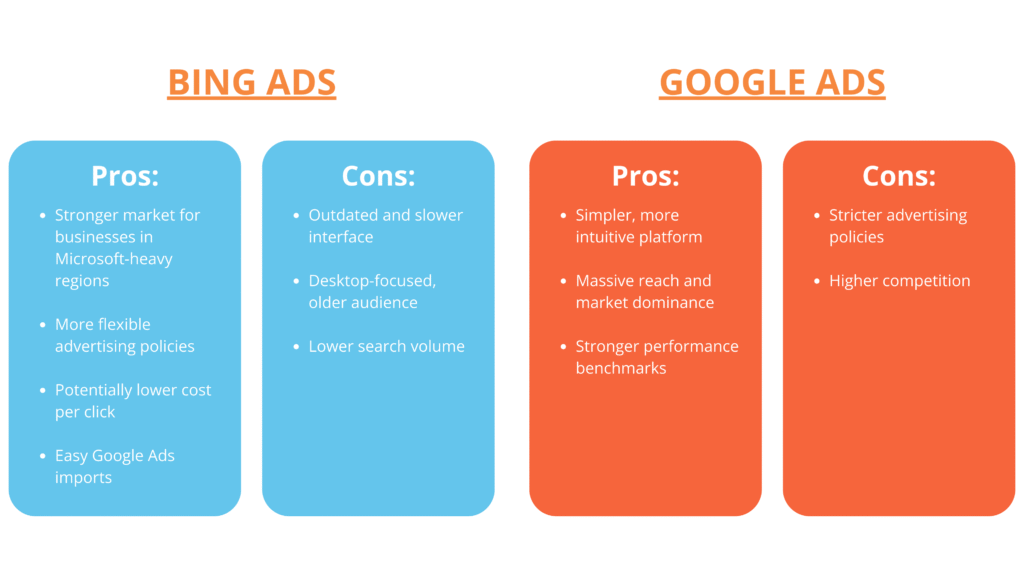
Stronger market for businesses in Microsoft-heavy regions
Microsoft’s influence is especially noticeable in areas like the Greater Seattle Area, where the company is headquartered. In regions with a high concentration of Microsoft employees and enterprise users, Bing usage is above the national average, making Microsoft Ads particularly valuable for local businesses in these areas.
More flexible advertising policies
One key differentiator between Bing and Google is what you’re allowed to advertise. For example, according to Accelerated Digital Media, certain healthcare services, like stem cell treatments, may be restricted on Google Ads but allowed on Microsoft Ads. This flexibility can paint a clear advantage for Bing Ads, depending on your industry.
Potentially lower cost per click
While Odd Dog has seen that the average cost per click is often comparable between Bing and Google, some industry leaders report that Microsoft Ads frequently delivers a lower cost per click due to less competition. Fewer advertisers bidding on the same search terms may result in more efficient spending for small businesses.
Easy Google Ads imports
Microsoft provides a tool that allows you to import your Google Ads campaigns into Microsoft Ads. Even better, you can schedule recurring imports so changes made in Google Ads automatically sync to Microsoft Ads. This makes Microsoft Ads a convenient add-on rather than a completely separate workload.
Cons of Bing Ads
Outdated and slower interface
The Microsoft Ads platform feels dated compared to Google Ads. Navigation can be slower, and some tasks require more clicks than they should. While functionality is similar, the user experience isn’t as polished.
Tip: Bing Ads Certification
To help ease the learning curve, Microsoft offers a Bing Ads certification program that helps users quickly understand the platform and build well-optimized campaigns with confidence.
Desktop-focused, older audience
Bing tends to attract more desktop users and an older demographic. For certain industries, this could be valuable and worth considering, but for many, the lack of demographics could make Bing a less successful platform for your business.
Lower search volume
Bing simply doesn’t generate the same search volume as Google. According to impressiondigital.com, Google serves approximately 1 billion users daily, while Bing sees roughly 100 million daily users, 90% less traffic than Google. As a result, impressions and overall performance are often limited on Bing, even with well-optimized campaigns.
Pros of Google Ads
Simpler, more intuitive platform
Google Ads is generally easier to use, with clearer workflows and better-organized tools. This makes campaign management faster, especially for lean marketing teams, and when you’re doing routine account check-ins or audits.
Massive reach and market dominance
With a majority of the search market share, Google Ads often leads the way in paid search trends. More users mean more impressions, more clicks, and more potential conversions, especially for competitive keywords.
Stronger performance benchmarks
In a direct comparison of Google and Bing, Google Ads showed a roughly 1% higher conversion rate than Microsoft Ads. While that may seem small, it can add up significantly at scale.
Cons of Google Ads
Stricter advertising policies
Google limits what industries and terms can be advertised. Some businesses simply have fewer opportunities to market their services compared to those offered by Microsoft Ads.
Higher competition
Because many businesses use Google Ads, competition is fierce. This could drive up the average CPC for the desired search terms, making it harder for a business to stand out. The average CPC may also change throughout the year, depending on the season and user shopping behaviors. If you plan to advertise on Google Ads, consider how the rest of your marketing strategy aligns with it. Advertisers who also consider maintaining a healthy website and improving their organic search rankings through search engine optimization have a better chance of generating traffic and leads on their website.
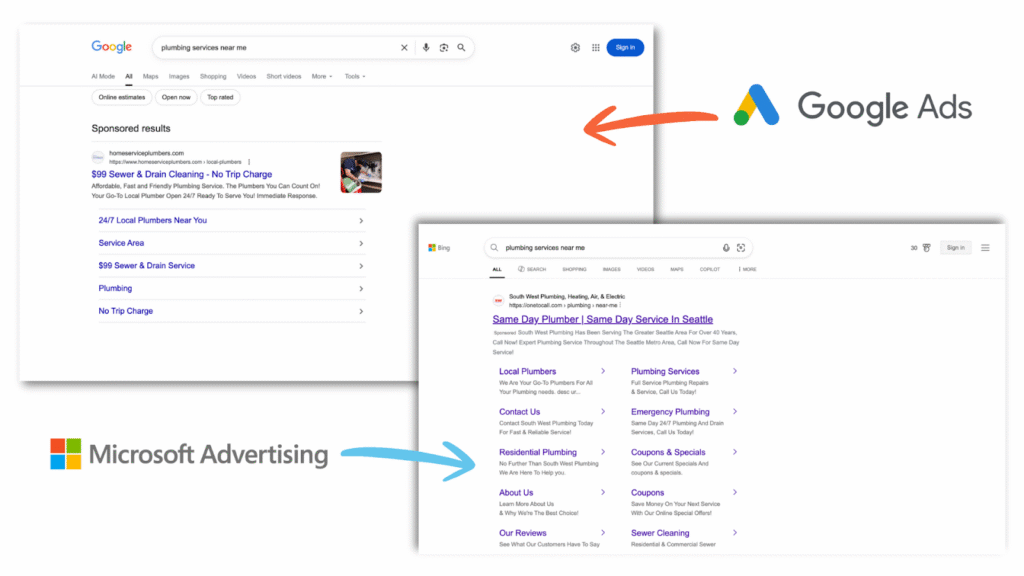
Bing Ads vs. Google Ads: Recommendations for Small Businesses
The biggest takeaway when comparing Bing Ads vs. Google Ads is this: diversification in your marketing mix matters.
You can’t assume that every person in your target audience is reachable through one channel alone. While Google Ads should typically be the foundation of your paid search strategy, Microsoft Ads can also serve as a valuable supplemental channel.
For most small businesses, we recommend viewing Microsoft Ads as an add-on to Google Ads rather than a replacement.
If you’re running both platforms, a good starting point is 80% of your budget on Google Ads and 20% on Microsoft Ads. From there, keyword research, CPC estimates, and real performance data should guide adjustments. Always remember that there is no perfect allocation; pay attention to what performs best for your business.
Need Help Getting Started?
As a Bing Ads agency with experience across multiple pay-per-click advertising platforms, Odd Dog helps small businesses build efficient, scalable paid search strategies. If you have unanswered questions or want expert guidance on Bing Ads, Google Ads, or both, we’d love to chat with you.