


Updated 4/21/26
Key takeaways:
- Direct/None is GA4’s catch-all for sessions when no referral source could be identified
- It is not always bad traffic, but a spike above 30% usually warrants investigation
- Consistent UTM tagging across your team is the most effective way to reduce it over time
If you’re trying to make sense of your website traffic in Google Analytics 4 (GA4), you’re not alone. GA4 breaks your visitors down into channels like Organic Search, Paid Search, Email, and Referral, but one channel tends to confuse even experienced marketers: Direct/None.
No referrer. No campaign. No source you can point to.
This guide walks you through how to check website traffic in Google Analytics, how to read what GA4 is actually telling you, and what to do when Direct/None is taking up more space in your reports than you’d like.
How to check website traffic in Google Analytics 4
Before diving into Direct/None specifically, here’s where to find your website traffic data in GA4.
Go to Reports > Acquisition > Traffic Acquisition. This is your primary view for understanding Google Analytics website traffic. It shows you every channel driving sessions to your site, how much traffic each channel sends, and how those sessions are performing in terms of engagement rate, conversions, and more.
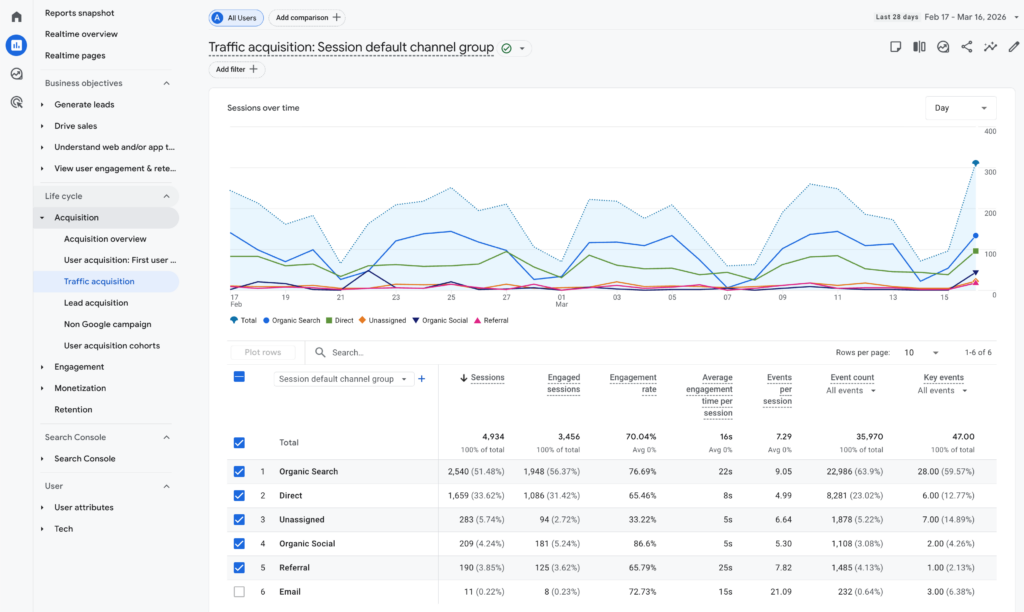
The default grouping is the Session default channel group, which organizes traffic into categories like:
- Organic Search
- Direct
- Referral
- Paid Search
- Organic Social
- Unassigned
You can also switch the primary dimension to Session source/medium for a more granular view. This is where you’ll see entries like “google / organic” or a specific UTM-tagged campaign.
Session: When a user either opens your app in the foreground or views a page or screen on your website. A session ends or times out after 30 minutes of user inactivity. There is no limit to how long a session can last.
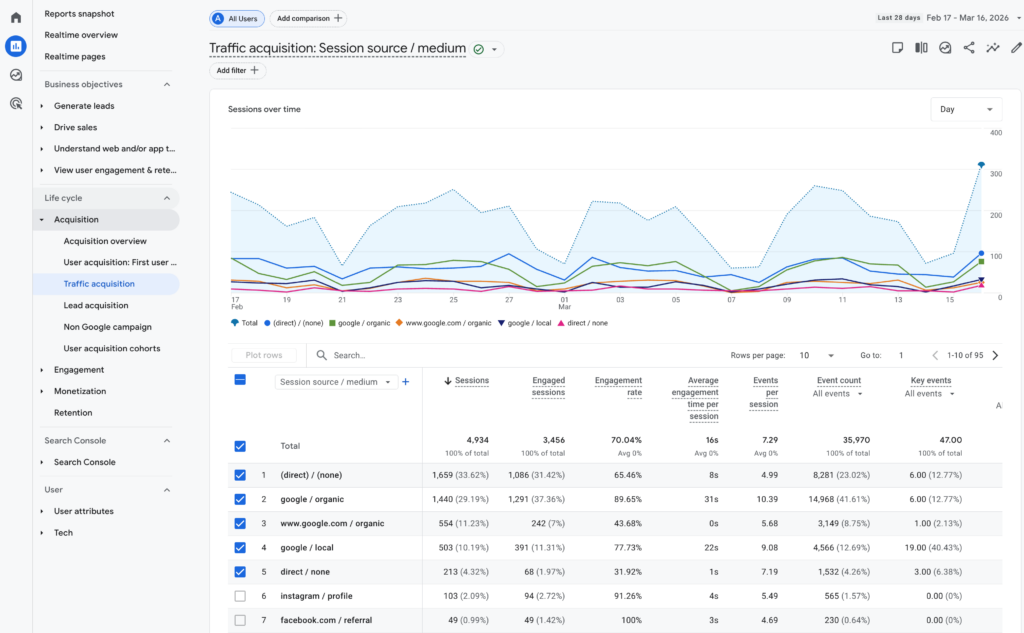
Getting familiar with this report is the foundation for everything else. Once you know what your traffic mix looks like, anomalies like a spike in Direct/None become much easier to spot.
What is direct traffic (Direct/None) in Google Analytics?
Direct traffic in Google Analytics is sessions where GA4 could not determine how the user reached your site. It is not necessarily someone who typed your URL into a browser. That is just one piece of it.
A good rule of thumb: direct traffic in the range of 10% to 20% of total sessions is generally considered normal and can reflect genuine brand awareness. If you’re consistently seeing more than 30%, it’s worth digging in. That level usually points to a tracking issue rather than an unusually strong brand recall.
Here is a more complete list of what typically gets lumped into Direct/None:
- Someone typed your domain directly into their browser
- Someone clicked from a saved bookmark
- Someone clicked a link inside a desktop application like Outlook or Slack
- Someone clicked a link from a PDF document or other offline documents
- Someone clicked through from a mobile app
- Someone used a URL shortener that does not pass referrer data
- Someone navigated from an HTTPS site to a non-HTTPS page, causing the referrer to be stripped for security reasons
- Someone had an ad blocker active, which can interfere with tracking cookies and hide referral information
- Someone arrived via “dark traffic,” meaning a link shared in a private channel like WhatsApp, iMessage, or a direct Slack message, where no referrer data is passed
The common thread is that no referrer data made it to GA4, so the session ends up in Direct/None by default.
A large spike in Direct/None traffic is not always a problem, but it should be investigated. Here’s how.
Step 1: Filter your traffic to Direct/None only
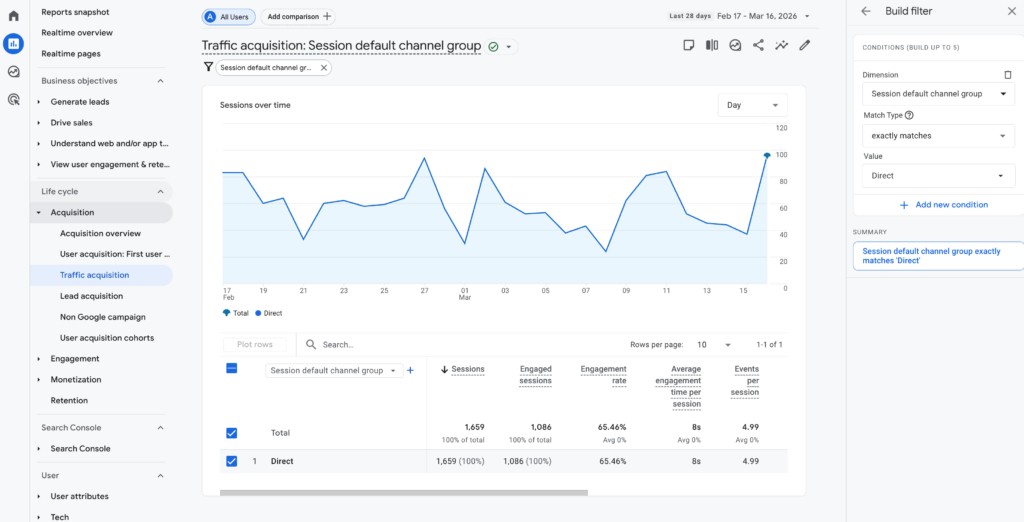
In GA4, navigate to Reports > Acquisition > Traffic Acquisition.
Use the filter icon at the top of the table to filter by Session default channel group = Direct.
This isolates all Direct sessions so you can dig into what’s happening without noise from your other traffic sources.
Step 2: Look at which landing pages are getting direct traffic
Once you’ve filtered, apply a secondary dimension of Landing page to see which URLs your Direct/None users are hitting first. Ask yourself:
- Are these your homepage and top-level service pages? That’s pretty normal.
- Are these deep interior pages like a specific blog post? That signals there’s likely a non-public link somewhere driving traffic, such as an email campaign without UTM parameters.
- Are these pages intended to be accessible only internally? That could point to a tracking or configuration issue.
- Have you run campaigns in the date range? The postcards you sent last month may be the reason for the uptick.
Landing page data is often the most telling piece of the Direct/None puzzle.
Step 3: Check where your direct traffic is coming from geographically
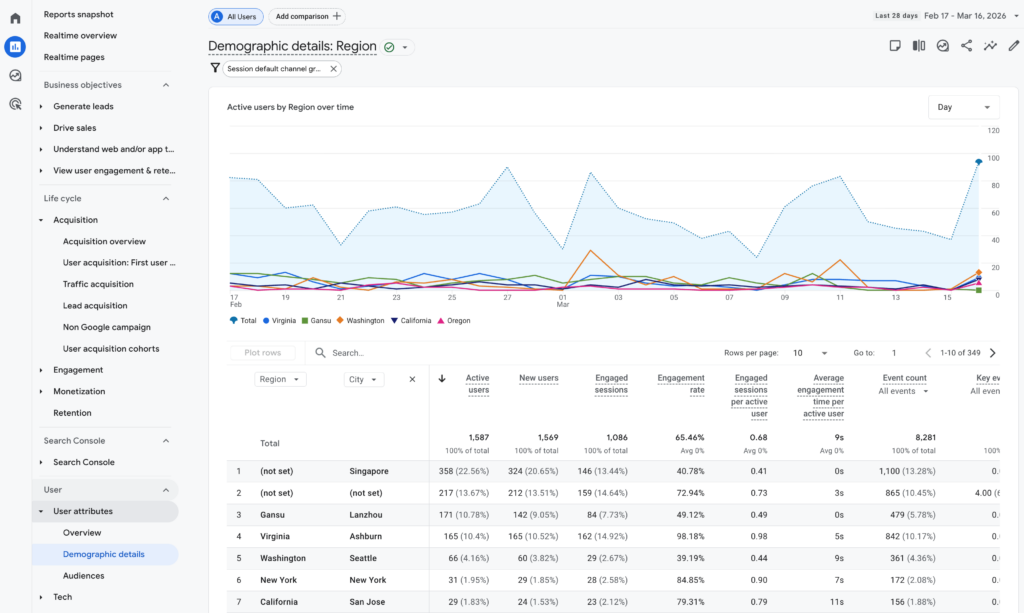
Head to Reports > User > User Attributes > Demographic Details and look at where your Direct/None users are located. The default dimension is County, but you can change it or add a secondary dimension, such as City or Region.
If you’re a local business and you’re suddenly seeing a spike in Direct traffic from countries where you don’t operate, that’s a red flag. It could be bot traffic or referral spam. If your Direct traffic matches the geographic footprint of your actual customer base, that’s a healthy sign.
Step 4: Is your direct traffic converting?
This is the most important question: Is this traffic actually doing anything useful on your website?
In GA4, go to Reports > Engagement > Events and filter for Direct traffic. You can add Is Key Event as a secondary dimension to distinguish between Events and Key Events. Look at whether this segment is:
- Completing key events like form submissions, phone clicks, or purchases
- Spending meaningful time on your site
- Visiting multiple pages
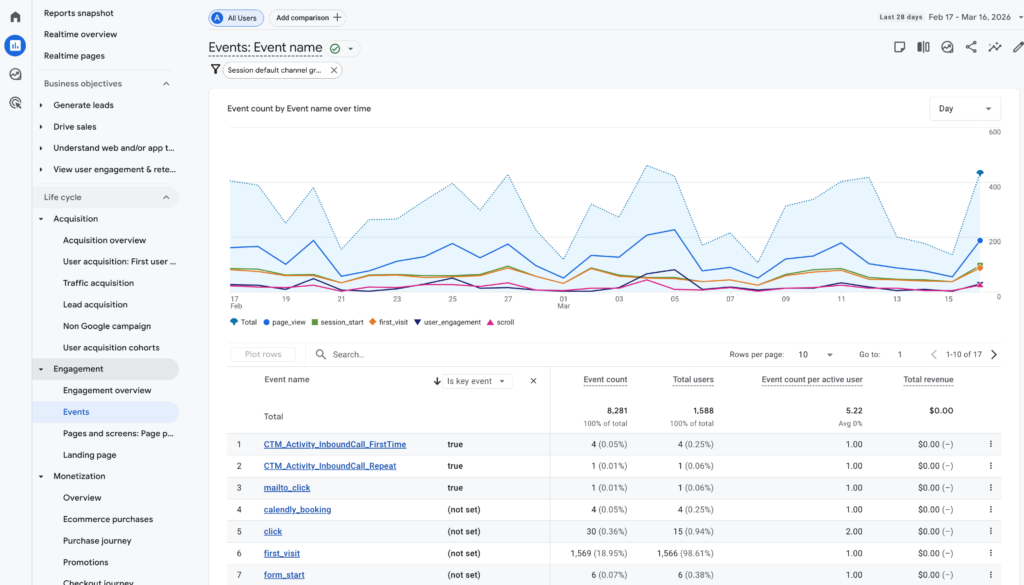
If your Direct traffic is converting at a rate similar to your other channels, it’s likely real, engaged users who are simply underattributed. If it’s bouncing immediately with no engagement, it may be low-quality or spam.
To easily compare Direct traffic conversions with other channels, go back to Reports > Acquisition > Traffic Acquisition, and you will see the number of Key Events by channel grouping.
If you want to dig deeper into your GA4 data beyond standard reports, our guide to connecting GA4 and BigQuery walks through how you can get more out of your raw event data.
Step 5: Reduce Direct/None traffic at the source
Here’s the real fix: the more consistently you tag your links by adding UTM parameters, the less Direct/None traffic you’ll have to scratch your head about in your website traffic reports in Google Analytics.
Use UTM parameters everywhere you control the link. This includes:
- Email newsletters and drip campaigns
- Email signatures
- PDFs, case studies, and proposals
- Links in project management and communication tools
- Any partnerships or campaigns where you’re supplying the URL
One thing teams often overlook: GA4 is case-sensitive. If one person tags a link with utm_medium=Email and another uses utm_medium=email, GA4 treats those as two separate traffic sources. Establish a simple naming convention that your whole team follows and stick to it. Consistency matters as much as coverage.
Google’s Campaign URL Builder makes the tagging itself simple. Paste in your URL, add your source, medium, and campaign details, and it generates a tagged link. It takes about 60 seconds and pays off every time you open a traffic report. You don’t need to add custom UTM parameters to Google sources, as it will automatically parse that data in GA4, unless you want to change your naming conventions. For all other sources, it’s good to add UTM parameters to be safe.
UTM Breakdown/Usage
- Source = the specific origin of traffic (google, facebook, direct)
- Medium = the general category or method of acquisition (organic, cpc, referral)
- Campaign = the specific campaign
Other ways to analyze Direct/None traffic in GA4
Device type. While reviewing your geographic data in Step 3, add Device category as a secondary dimension. A Direct traffic spike that’s heavily mobile often points to dark social sharing from apps like iMessage or WhatsApp. A desktop-heavy spike is more likely to be genuine bookmarks or typed-in URLs. The mix tells a different story than the total.
Your marketing calendar. GA4 doesn’t tell you why a spike happened, but your own records can. If you recently sent an untagged email or ran an offline promotion, cross-reference those dates against your Direct traffic trend. The timing alone often answers the question.
Missing tracking code. If Direct traffic is concentrated on interior pages that shouldn’t be entry points, check whether your GA4 tag is installed on every page of your site. A page missing the tracking script can cause GA4 to start a new direct session when a user navigates to a tagged page, inflating your numbers. Google Tag Assistant can help you audit this quickly.Multiple domains or subdomains. If your site sends users to a separate checkout page, booking tool, or subdomain, and cross-domain tracking isn’t configured in GA4, those handoffs will register as new Direct sessions. This is a common and underdiagnosed source of Direct inflation for businesses with third-party booking or e-commerce platforms.
The bottom line on understanding Google Analytics website traffic
A healthy GA4 account will always have some Direct/None traffic. That’s just the nature of the channel. But understanding Google Analytics website traffic means knowing when Direct/None represents normal user behavior that can’t be fully tracked versus something worth investigating.
Work through the steps above when you see unusual spikes, make UTM tagging a habit for any link you control, and over time, you’ll shrink the mystery bucket and get a much clearer picture of what’s actually driving results.
Need help making sense of your GA4 data? If you’re wondering whether your current setup is giving you accurate data or considering choosing the right digital marketing partner, we’re happy to talk through it.
Our team at Odd Dog works with businesses every day to clean up tracking, interpret what the numbers actually mean, and tie it all back to real business outcomes. Let’s talk.
